You are standing in the coop with two feed bags open, looking at birds that are no longer quite chicks but not clearly hens either. One pullet suddenly seems almost full-sized. Another has started crouching. You know eggs cannot be far off, and that is exactly when feeding gets weirdly stressful: switch now, wait longer, or risk creating a problem that will not show up until later.
We see this moment all the time, and it matters more than many backyard chicken owners expect. Most feeding mistakes do not happen on day one. They happen in the handoff points: moving off starter too early, hanging on too long, offering layer feed before birds are actually laying, or letting scratch and treats crowd out what should still be a complete ration.
The good news is that chicken food does not have to feel complicated once you organize it by life stage and by real-world signals. For most backyard flocks, the job is simple: match the feed to what the bird’s body is trying to do right now, then keep that staple consistent enough that extras do not undo it.
Here is the big picture we use when owners need fast orientation. Chicks start on starter feed. As they move past the earliest growth stage, they shift to a grower or developer feed. Once pullets are actively laying, they transition to layer feed. The exact week can vary by breed and development, which is why birthdays alone are not the whole story.
- Starter feed: for chicks in their earliest growth phase, when steady development matters most.
- Grower or developer feed: for the in-between stage, when birds are bigger but not yet laying.
- Layer feed: for hens that are actively producing eggs and need the added calcium support built for that job.
- Wait signal: a pullet looks older, but no one is laying yet.
- Move-now signal: the first eggs have started arriving, or laying is clearly underway in the birds meant to produce eggs.
- Ongoing rule: treats, scratch, and kitchen extras should stay secondary to a complete feed.
Starter feed is not just small chicken food for small chickens. It is formulated for a very specific stage of life when chicks are building the foundation for everything that follows: frame, feathering, muscle, organ development, and early overall health. This is why the first feed matters so much. At this stage, we do not want to dilute the ration with fun extras or rush toward the next bag because the birds seem to be growing fast.
In practical terms, chicks need consistency more than variety. A quality starter feed gives them the concentrated nutritional base they need while they are doing the fastest developmental work of their lives. Owners sometimes get tempted to move on early because the birds look bigger, seem hungry all the time, or are starting to act less like babies. None of that means they are ready for layer feed.
- General stage: from hatch through the early growth period.
- Main goal: support safe, steady growth and early body development.
- Common mistake: adding too many treats or scratch so the complete ration no longer makes up most of what the chicks eat.
This is the stage that confuses people most. The birds are no longer tiny. They look sturdy. They may be feathered out and moving through the coop with confidence. But looking almost ready is not the same thing as being nutritionally ready for a laying ration.
That is where grower or developer feed comes in. Depending on the feed line, you may see one name or the other, and sometimes the categories are combined. What matters is the purpose: this feed bridges the gap between early chick growth and actual egg production. It supports continued development without jumping ahead to the higher-calcium profile designed for laying hens.
We like to think of this as the patience stage. Your pullets are still finishing important growth, and their bodies are not yet doing the mineral-intensive work of shell production. If you switch too early just because they are nearly hen-sized, you can create an imbalance before there is any real laying benefit to offset it.
- General stage: after starter, before active laying begins.
- Main goal: support continued growth without premature layer nutrition.
- Common mistake: using appearance alone to decide that a pullet is ready for layer feed.
Layer feed starts when hens are actually laying
Layer feed has a clear job: it supports egg production, including the calcium demands that come with building shells regularly. That is why first egg matters so much. Layer feed is not a reward for getting close. It is not the default adult chicken food for every bird in the coop. It is the right ration for hens that have started laying.
That distinction saves people from one of the quietest backyard feeding mistakes: assuming older pullets should move to layer feed just because the calendar says they are near the usual age range. In reality, some breeds mature sooner, some later, and individual birds do not read charts. If you switch because you are impatient for eggs rather than because laying has begun, you are solving the wrong problem.
Once laying is underway, though, this stage becomes important. Hens need a complete feed built for the demands of consistent production. If the main ration is weak, inconsistent, or regularly displaced by too many extras, shell quality and overall condition can suffer over time.
- General stage: when pullets become actively laying hens.
- Main goal: support egg production and shell formation with a complete laying ration.
- Common mistake: moving the whole flock to layer feed before the non-laying birds are actually ready.
The real switch question is not just age. It is readiness.
If there is one idea we want owners to hold onto, it is this: use age as a guide, not as the only trigger. Feed transitions work best when you combine the general age window with what the birds are showing you.
Body development matters. Breed variation matters. Flock role matters. And first egg matters a lot. A fast-maturing bird may reach the next phase before her slower flock mate does. A rooster will never become a layer just because the hens around him did. A mixed backyard flock almost always asks you to think beyond one shared birthday on paper.
That is why the safest mindset is to ask, “What is this bird’s body doing now?” A chick is building. A grower is still developing. A laying hen is producing eggs. Once you frame chicken food that way, the transitions make more sense and feel much less arbitrary.
We also encourage owners not to wait until the feed bin is empty and everyone is half-transitioned before making a decision. Keeping the next appropriate feed on hand before the shift arrives makes the process calmer, more consistent, and easier on you.
Mixed backyard flocks need a practical setup, not a perfect one
This is the part many generic feeding charts skip. Real backyard flocks are messy in the normal way: a few pullets are nearly ready, older hens are already laying, maybe there is a rooster in the mix, and everyone seems to want to eat from the same place at the same time.
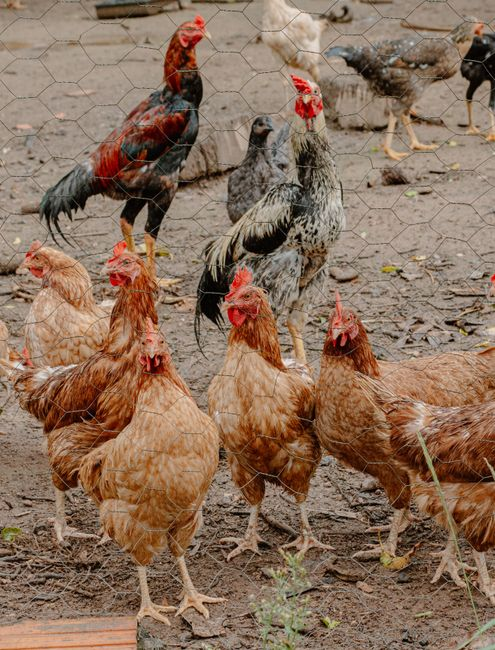
When pullets and laying hens overlap, the main priority is avoiding nutrient gaps and avoiding unnecessary calcium exposure for birds who are not laying. In many home setups, that means thinking carefully about whether your not-yet-laying birds can stay on a grower-type complete ration a bit longer while laying hens get access to calcium support separately, rather than assuming every bird should move to layer feed together just to simplify chores.
Roosters complicate this too, because they do not need a layer ration in the same way laying hens do. In mixed flocks, free-choice oyster shell or another calcium source for laying hens can be a more sensible tool than trying to solve every bird’s needs with one identical feed bowl. The point is not to make your coop management elaborate. It is to keep the complete ration appropriate while giving laying hens access to what shell production requires.
If that sounds like a lot, this is where dependable feed quality and consistent stocking really help. A stage-appropriate chicken food you trust makes daily management simpler, especially when your flock is in one of those transitional windows where guessing gets expensive later.
What quietly throws off a good feeding plan
Most owners do not mean to weaken the ration. It happens gradually. A handful of scratch becomes a daily habit. Kitchen scraps start feeling generous. Treat time gets bigger because the flock gets excited. None of those choices feels dramatic in the moment, which is exactly why dilution is so easy to miss.
The issue is not that chickens can never have extras. It is that extras cannot become the nutritional center of the day. A complete chicken food is designed to do the real work. Scratch, treats, and leftovers are not. When birds fill up on lower-value extras, they eat less of the feed that was supposed to support growth, development, laying, and overall balance.
Premature calcium fits into this category too. Owners sometimes try to “get ahead” of egg laying by switching early to layer feed, but more is not always better when it is not matched to the bird’s stage. In chicken feeding, timing matters almost as much as ingredient quality.
Questions we hear when a flock is between stages
What if one pullet starts laying earlier than the others?
That is common. Early layers can show up before the whole group is ready. In that situation, it helps to think in terms of flock management rather than panic-switching everyone overnight. The goal is to support the bird that has started laying without forcing every still-developing pullet onto a laying ration too soon.
Can roosters eat the same chicken food as laying hens?
Roosters are one reason mixed-flock feeding takes a little thought. They do not have the same laying-related calcium needs as hens. In mixed backyard setups, many owners do better when they keep the main feeding plan grounded in life stage and use separate free-choice calcium for the hens who need it, instead of assuming the entire flock should live on layer feed.
My birds are the “right age” but still have not laid. Should I switch anyway?
Usually, no. Age ranges are helpful, but they are not guarantees. Breed, season, development, and individual variation all influence first egg timing. If your pullets are not actively laying yet, staying patient and keeping them on the appropriate pre-lay ration is often the steadier choice.
Do treats change by age too?
Yes, in the sense that younger birds have less room for nutritional dilution. Chicks and growing birds especially need their complete feed to remain the main event. As birds mature, extras still need limits. We treat them as extras on purpose, not as a meaningful share of the diet.
How do I know when a feeding issue is serious enough to ask for help?
If birds are growing poorly, laying weak-shelled eggs, showing a noticeable drop in condition, or behaving as though something is off beyond a simple transition question, it is worth getting poultry-experienced guidance. Feeding mistakes can be subtle at first, and getting support early is easier than trying to correct a bigger problem later.
When you keep the life-stage roadmap clear and the complete ration steady, chicken food becomes much less confusing. Starter for early growth, grower for the in-between stretch, layer for active egg production, and fewer extras than your flock would probably vote for. That rhythm works especially well when you plan ahead and keep the next appropriate feed ready before the transition sneaks up on you.